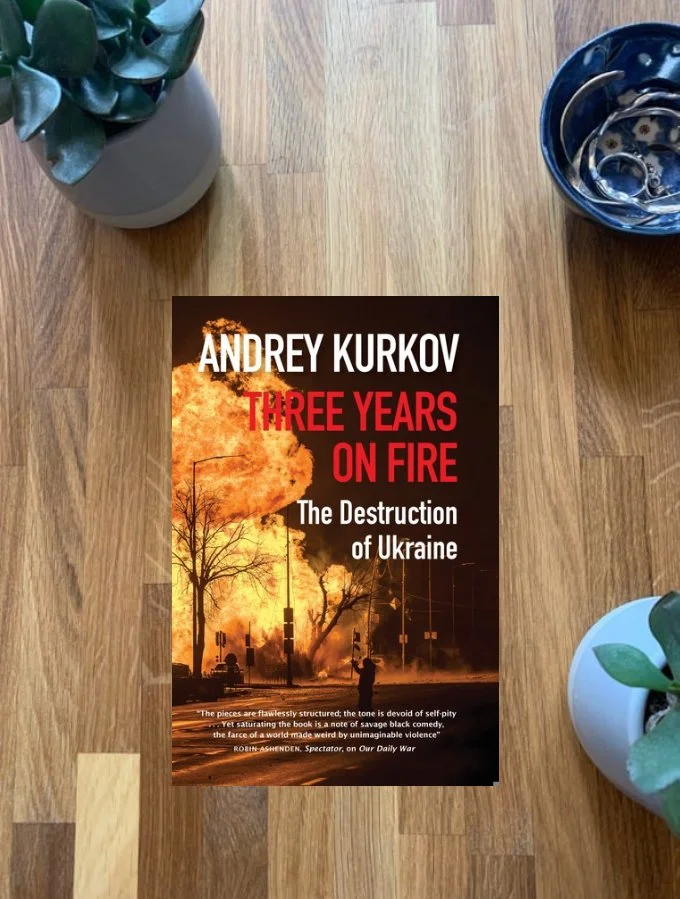
Three Years on Fire by Andrey Kurkov
In this third volume of Andrey Kurkov's war diaries, Ukraine's greatest living writer chronicles the third year of the full-scale invasion from his home in Kyiv and from journeys all over the country - capturing moments of horror, resilience, absurdity and grace with unmatched clarity.
Children on a contested border wear hooded bulletproof vests to school; soldiers write haiku; professional clowns go to war; and the mother of a young soldier killed in battle uses his compensation money to create a rehabilitation centre for veterans.
Roses bloom across Ukraine in quiet tribute to a florist and soldier killed in Avdiivka, remembered by those who once bought his flowersThe Dnipro River seems to slow when the first missiles fall, as though nature itself had paused in shock. In Pokrovsk, 7,500 residents refuse to leave a city that no longer exists - their homes obliterated but their will unbroken. A general's seventeen-year-old pet toad becomes an iconic symbol of defiance. And buried beneath a cherry tree, a murdered writer's final diary is recovered, a haunting echo of a silenced voice.
From the home front to the trenches, Kurkov captures the rhythms of survival - the quiet rituals, unlikely joys, unexpected humour and appalling costs - in an intimate and astonishing record of national endurance. Three Years on Fire is a luminous act of remembrance, rich with unforgettable detail and human spirit, from a writer whose voice stands witness to everything Ukraine has lost - and everything it refuses to give up.

About the author
Andrey Kurkov was born near Leningrad in 1961 and graduated from Kyiv Pedagogical Academy of Foreign Languages in 1983. After working as a prison guard in Odesa and as a journalist, he self-published his texts and found renown as a novelist. His novel Death and the Penguin, his first in English translation, became an international bestseller, translated into more than 43 languages, and has been in print since its publication in 2001.
Since the beginning of the Russian invasion, the author has published unrivalled reports from his war- torn country in newspapers and magazines all over the world. He has been a regular presence on radio and television, including BBC Radio 4's
"Letter from Ukraine"
', and travelled worldwide to
lecture on the perilous state of his country. He has, in the process, become a crucial voice for the people of Ukraine. Of his war journals, Diary of an Invasion was published in 2022 and Our Daily War in 2024.
As part of the blog tour I have the pleasure of sharing an extract from the book.
24.06.2024
Generating Electricity and Crime
Over the last two months, Kyiv has started to sound like a tractor factory. I have never been inside one, but the noise on many of the city’s streets brings to mind a heavy machinery plant and it comes from the petrol-powered generators which have come to replace mains electricity.
Every 15 to 20 metres along Yaroslaviv Val – a café-lined street near the Golden Gate – generators stand rumbling from the early morning. The noise goes on all day except, perhaps, for three or four hours in the afternoon, when mains electricity reappears and the street becomes blissfully quiet.
In the evenings, the power goes off again and the low grumble of generators fills the air. Power-cut schedules for each city district are available online, and businesses – especially bars and restaurants – are careful to ask customers using bank cards to pay before the power goes off and the time for candlelight and cash begins.
As well as increasing noise pollution, power outages have been the indirect cause of fires in apartments. Kyiv residents who can afford them buy mini-generators and power hoarding devices that allow them to keep domestic appliances working when there is no mains electricity. People with less money must be creative and many connect car batteries to their apartment’s electrical system. As soon as the power is restored to their building the first thing people do is charge everything that can be charged: their power banks, mobile phones, computers and, if they are using one for power supply, their car batteries. Several of these D.I.Y. systems have exploded while being charged, sometimes causing serious injury and damage to buildings.
At the same time, fires of a rather different nature have become a feature of night-time Kyiv. Parked cars are being set alight, and the vehicles concerned invariably belong to military personnel or military units. The pattern was soon noticed by police and security services. Their investigations led to the arrest of some unlikely culprits: thirteenor four-teen-year-old young people. It seems that the Russian specialservices are offering Ukrainian teenagers “some extra money” in exchange for acts of arson. The Russian services approach teenagers whose activity on social media indicates that they may be interested in this work. First, they are offered between $100 and $300 to leave antiUkrainian graffiti on exterior walls. The teenagers are expected to send pictures of their handiwork to their Russian clients, who, if satisfied, then ask the young people to set fire to Ukrainian military vehicles in return for a much larger reward.
Russian handlers tell the teenagers that, even if they are caught, they are too young to be prosecuted. What the Russians do not explain is that acts of arson committed on the orders of enemy forces are classified as terrorism, and, in Ukraine, the age of criminal responsibility for acts ofterrorism is fourteen.
A mother and her fourteen-year-old son were detained especially to earn money by committing arson. The mother explained that she had accrued large debts and had no other way of paying them off.
It seems Russian special services have enough human resources to monitor the activity of Ukrainian children on social networks. I wonder whether this army of spies is divided into units according to the age group they are targeting, but I assume that influencing Ukraine’s adult population remains the priority for Russia. Thousands of Russian bots
are planted in Ukrainian chats dedicated to conscription and how to evade it, or when and how the war might end. The bots are there to stir up and maintain panic and, of course, to persuade men to evade conscription.
Resistance to mobilisation inside Ukraine cannot be blamed entirely on Russian interference, but the recent spike in the number of attacks on the employees of military registration and enlistment offices does indicate that outside forces are at play and that they are having an effect. Conscription office employees are attacked in the course of their officialduties – for example, when delivering call-up papers to individuals – as well as on their way home from work. A targeted campaign against the conscription system has evolved, prompting Parliament to vote in a law on the establishment of a specialised military police force with the same structure as the regular police force but one that will support theemployees of military registration and enlistment offices and search for draft dodgers. The officers will have more invasive powers than ordinary police, allowing them to enter private homes without a court order. They will also patrol populated areas and have the right to stop and search cars and, of course, check the documents of drivers, passengers and pedestrians.